
The Temple
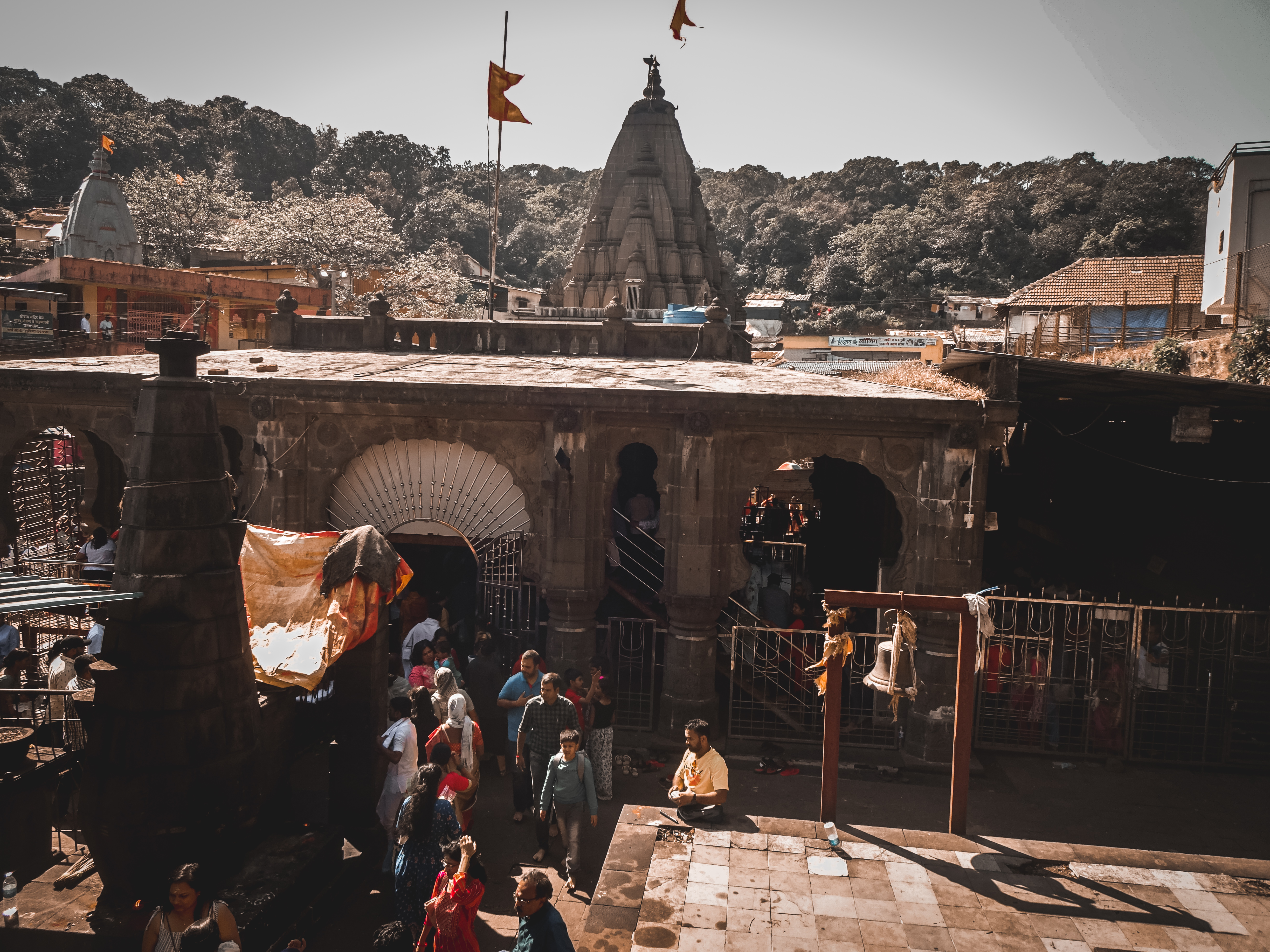
Bhimashankar Temple is located in the Sahyadri hills (Western Ghats) of Maharashtra, about 110 km from Pune. It sits on a hill at approximately 3,300 feet altitude, surrounded by dense forest that is a protected wildlife sanctuary — home to the Giant Indian Squirrel (Shekru). The temple gets its name from the demon Bhima (not the Pandava) — a son of the demon king Kumbhakarna (Ravana's brother). The Bhima River originates near this temple.
The Sacred Story

Where Shiva vanquished demon Bhima — deep within the Sahyadri wildlife sanctuary
The Epic Legend of Bhimashankar: The Destroyer of Evil
Bhimashankar in the Sahyadri mountains is where Bhima — son of demon Kumbhakarna — performed extreme penance to avenge his father.
Part 1: Mythological Events (The Vengeance of Demon Bhima)
1. The Vengeance of Demon Bhima
Deep in the dense forests of the Sahyadri mountains lived a formidable demon named Bhima and his mother, Karkati. For years, Bhima was ignorant of his true lineage. One day, he asked his mother about his father and learned a shocking truth: he was the son of Kumbhakarna, the giant brother of the demon king Ravana of Lanka.
When his mother revealed that his father and uncle were slain by Lord Rama (an avatar of Lord Vishnu), a burning desire for revenge consumed Bhima. He vowed to destroy Lord Vishnu to avenge his father's death. Knowing he needed immense power, Bhima performed severe and grueling penance to appease Lord Brahma. Pleased with his dedication, Brahma granted him extraordinary, almost invincible strength.
2. The Imprisonment of King Kamrupeshwar
Armed with this terrifying new power, Bhima went on a rampage across the three worlds, conquering gods, sages, and humans alike. He evicted the deities from the heavens and established a reign of terror.
During his conquests, Bhima attacked the kingdom of Kamarupa and defeated its noble ruler, King Sudakshina (also known as Kamrupeshwar). King Sudakshina was an ardent and unwavering devotee of Lord Shiva. The arrogant demon threw the king into a dark dungeon and ordered him to abandon Shiva and worship him instead.
Defying the demon, the pious king used the mud from the prison floor to fashion a makeshift Shiva Lingam. Day and night, he relentlessly prayed to the Lord for deliverance.
3. The Fierce Battle and the River of Sweat
Infuriated by the king's unyielding devotion, demon Bhima stormed into the dungeon with his heavy sword drawn, intending to shatter the clay Lingam and execute the king. Just as his sword came down, the Lingam split open, and Lord Shiva manifested in all his terrifying, cosmic glory—his third eye ablaze with fury.
A massive, earth-shattering battle ensued between the Supreme Lord and the giant demon. The fight was so intense that rivers of sweat poured from Lord Shiva's body. Eventually, responding to the prayers of Sage Narada and the terrified gods, Shiva let out a deafening roar that instantly reduced the demon Bhima to a pile of ashes, restoring peace to the universe.
4. The Manifestation of Bhimashankar
The gods and sages pleaded with Shiva to remain in that sacred forest to protect his devotees forever. Granting their wish, Shiva manifested there as the "Bhimashankar Jyotirlinga." Furthermore, the profuse sweat that had flowed from Shiva's body during the epic battle collected into a stream and formed the holy Bhima River (Bhimarathi), which continues to flow from these hills today.
Timeless Architecture

Bhimashankar Construction History: The Fortified Forest Shrine
The Bhimashankar Temple's architectural evolution is closely tied to its remote, rugged location within the dense Sahyadri forests.
1. Ancient Origins
While the Jyotirlinga itself is considered ancient and self-manifested (Swayambhu), the original shrine was likely a simple stone structure deep in the forest. For centuries, it remained a secluded pilgrimage site accessible only to the most determined ascetics and devotees who braved the treacherous mountain paths.
2. Hemadpanthi Architecture (13th Century Onwards)
The core of the present temple was built in the classic Hemadpanthi style, a distinctive architectural form native to Maharashtra. Developed during the Yadava dynasty, this style relies on massive, intricately carved black black stone slabs joined together entirely without mortar. This earthquake-resistant dry-masonry technique has allowed the temple to withstand heavy monsoon deluges for centuries.
3. Maratha and Peshwa Patronage (18th Century)
The temple saw substantial expansion during the 18th century under the Maratha empire and the Peshwas. Nana Fadnavis, a prominent minister of the Maratha Empire, made significant additions, including the prominent Shikhara (tower) and a grand Sabha Mandap (assembly hall). The entrance features a massive bell, a war trophy brought by Chimaji Appa, the brother of Peshwa Baji Rao I, after his legendary victory against the Portuguese at Vasai fort.
4. Conservation and Wildlife Sanctuary
Today, the temple complex sits within the protected Bhimashankar Wildlife Sanctuary, creating a unique synthesis of spiritual heritage and ecological conservation. The structure elegantly balances ornate stone carvings of human and divine figures with its wild, natural surroundings.
Revealing the Mysteries
Discover the fascinating secrets and divine phenomena of this sacred temple
Origin of the Bhima River: The Bhima River, one of Maharashtra's major waterways, originates directly from this temple. According to the Purana, the river was formed by the sweat pouring from Lord Shiva's body during his fierce battle with the demon.
Demon's Lineage: The temple's legend uniquely ties into the epic Ramayana—the demon Bhima was the son of Kumbhakarna and the nephew of Ravana.
The Sweating Lingam: Local tradition holds that the actual stone of the Jyotirlinga 'sweats' during peak summer, just before the monsoon rains arrive—a natural phenomenon revered as a weather indicator.
Wildlife Sanctuary: Bhimashankar is uniquely situated inside a dense protected wildlife reserve. It is one of the best places in India to spot the rare and beautiful Indian Giant Squirrel (Shekru), which is Maharashtra's state animal.
Hemadpanthi Architecture: The temple boasts classic Hemadpanthi architectural style, characterized by the use of intricately carved black stone without the use of mortar.
The Land of Jyotirlingas: Maharashtra is proudly home to the highest number of Jyotirlingas in India, hosting a total of six out of the twelve (depending on the specific scriptural interpretation followed).
✨ Each mystery reveals the divine presence within these sacred walls ✨
Explore All 12 Jyotirlingas
Twelve temples of divine light, spread across India — each a self-manifested Shiva Lingam.




← Swipe to see more →
Explore More Sacred Stories
Discover the legends and mysteries of India's ancient temples
View All Stories