
The Temple
Jambukeswarar Temple (Thiruvanaikaval) is one of the five Pancha Bhuta Stalas, where Lord Shiva is worshipped as the Water (Appu/Jala) Lingam. Located near Srirangam on the north bank of the Kaveri river in Tiruchirappalli, Tamil Nadu. The most miraculous feature: a natural spring perpetually wells up inside the sanctum (Garbhagriha), keeping the Shiva Lingam always submerged in water. Even during summer, the spring never dries up. Here, Goddess Akilandeswari is considered a disciple of Lord Shiva — a unique relationship that makes this temple exceptionally special among all Shiva shrines.
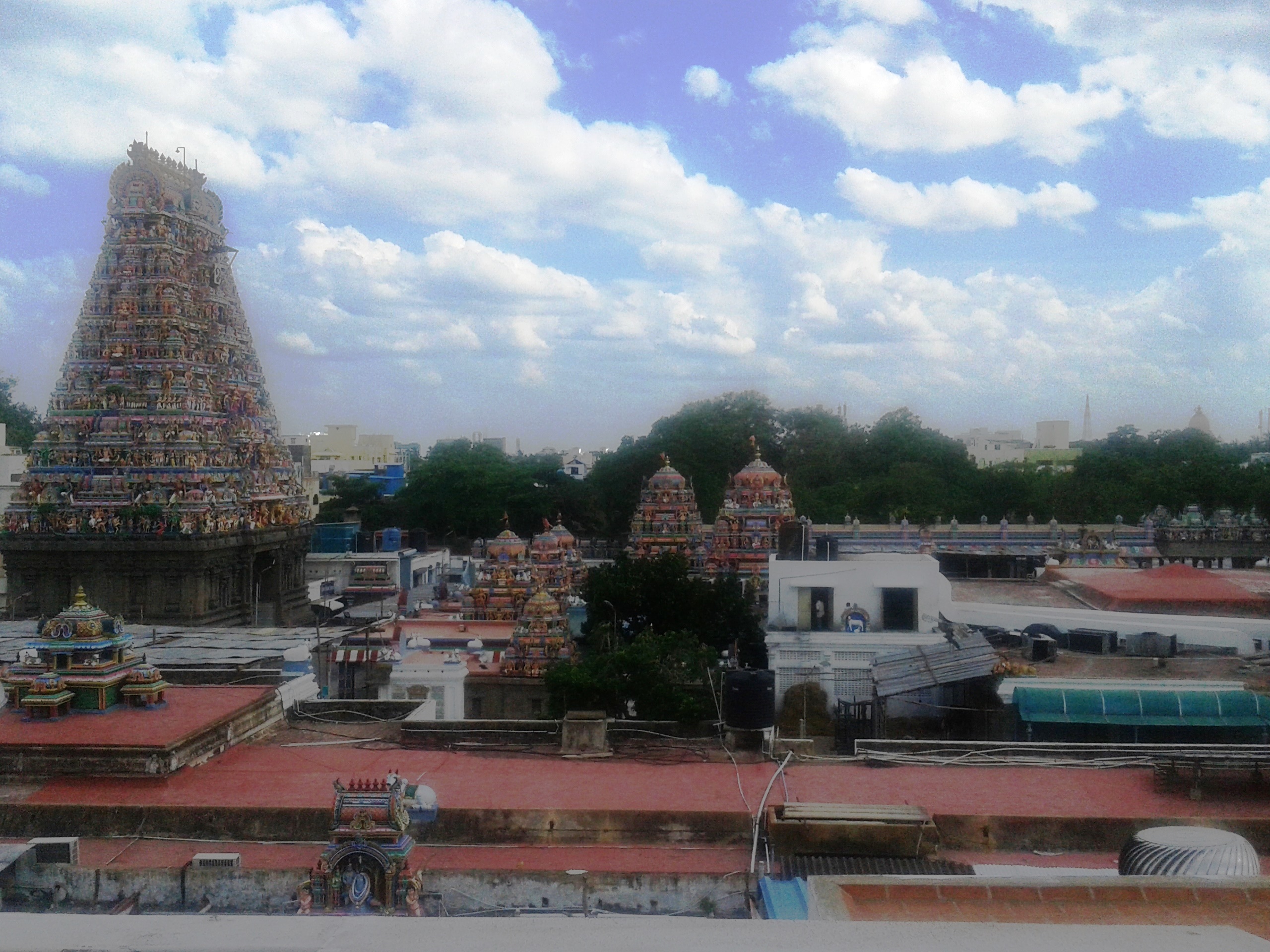
The Sacred Story

Where the Jala Lingam rises from an eternal spring — the water element sanctum of Thiruvanaikaval
The Complete History of Jambukeswarar Temple (Thiruvanaikaval)
This sacred kshetra is famous as the "Jala Lingam" (Appu Lingam - Water Element), the second of the Pancha Bhoota Stalas.
PARVATI'S PENANCE — The Birth of the Water Lingam
Once in Kailash, Goddess Parvati (Akilandeswari) mocked Lord Shiva's penance. The angered Shiva commanded her to be born on Earth and perform penance.
Parvati descended to Earth and arrived at a dense forest of Jambu trees (Neredu trees / Java Plum) on the banks of the Kaveri river. There she began an intense penance for Shiva.
• She had no Lingam to worship. So she took water (jalam) from the Kaveri river in her cupped palms and fashioned a Shiva Lingam out of that very water. • Water, one of the five elements (Pancha Bhutas), was solidified by her devotion into the form of a Lingam (Appu Lingam). • She installed that Water Lingam under a Jambu tree (Java Plum tree) and worshipped it with great sincerity.
Pleased by her devotion, Lord Shiva appeared and imparted Shiva Gnana (divine knowledge) to her. That is why here, the Goddess is regarded as Shiva's disciple. Since Shiva manifested under the Jambu tree, he came to be called "Jambukeswarar."
THE DEVOTION OF THE ELEPHANT & THE SPIDER
This is the most celebrated story of this kshetra, similar to the Srikalahasti legend.
Two of Shiva's attendants in Kailash — 'Malyavan' and 'Pushpadanta' — were always quarreling. Due to cursing each other: • Malyavan was born on Earth as a Spider. • Pushpadanta was born on Earth as a White Elephant.
Both arrived at the Jambu forest and began worshipping the same Jala Lingam that Parvati had installed.
• Spider's worship: From atop a tree, the spider wove a magnificent web like a canopy to prevent dry leaves and dust from falling on the Shiva Lingam. • Elephant's worship: Every day the elephant brought water in its trunk from the Kaveri river and performed abhishekam (ritualistic bathing) on the Lingam.
The Conflict: When the elephant arrived to worship, the spider's web would be on the Lingam. Thinking "what is this dirt on the Shiva Lingam?", the elephant would rip away the web with its trunk, clean the Lingam with water, and perform abhishekam. When the spider returned the next day, its painstakingly woven web would be destroyed. The spider would weave a new one. This happened every single day.
One day the spider realized the elephant was the one ruining its worship. Furiously, it entered the elephant's trunk and bit it hard. Unable to bear the terrible pain, the elephant slammed its trunk to the ground. In this battle, both the elephant and the spider perished.
Pleased by their pure devotion, Lord Shiva appeared and granted the elephant moksha. In Tamil, an elephant is called "Aanai." Because the elephant worshipped in this forest, the kshetra came to be called "Thiruvanaikaval" (Sacred Forest of the Elephant).
THE SPIDER'S REBIRTH — KOCHENGANNAN THE CHOLA KING
The elephant attained moksha, but the spider did not. Shiva blessed it to be reborn in the next life as a great king.
The Chola king Subhadeva and his queen Kamalavati had no children. They worshipped at Chidambaram, whereupon the spider entered Kamalavati's womb.
When the time of delivery approached, the royal astrologer said: "If we wait just one more 'ghadi' (a few minutes), the child about to be born will become a great emperor who rules the three worlds. If born now, he will be ordinary." Hearing this, Queen Kamalavati instructed her servants to hang her upside down (to prevent the womb from opening) until the auspicious moment arrived.
When that muhurta (auspicious time) came, she gave birth to a healthy baby boy. Due to being upside down, the child's eyes had turned red inside the womb. The mother passed away immediately upon seeing the child. Due to his red eyes, the king was named "Kochengannan" (One with Red Eyes).
The Temple's Construction: After becoming king, Kochengannan received memories of his past life (as the spider). With immense devotion to Shiva, he built this magnificent Jambukeswarar Temple.
• The Temple's Secret: The anger toward the elephant that had destroyed his worship (the web) in his past life remained within him. Therefore, the entrance door to the Garbhagriha (sanctum sanctorum) was built extremely narrow — only 4 feet high and 2.5 feet wide. No elephant can ever enter! Even devotees must bow down to enter.
Timeless Architecture

The Jambukeswarar Temple has a history spanning over 1,800 years. The original structure is attributed to the Early Chola period (2nd century CE), with Kochengannan Chola believed to have built the main shrine.
The temple has five enclosures and seven gopurams (gateway towers). The five enclosures reflect the tradition of Pancha Bhoota Sthalas. Over the centuries, later Chola kings and the Vijayanagara rulers made significant additions and renovations.
The temple complex covers about 18 acres, making it one of the largest temple complexes in Tamil Nadu. The Kaveri river running nearby is considered sacred, and the temple's association with water (the Jala element) is reflected in its unique natural spring inside the sanctum.
Revealing the Mysteries
Discover the fascinating secrets and divine phenomena of this sacred temple
Natural spring eternally wells up inside the sanctum — the Lingam is always submerged
Water level rises during monsoon and never dries even in peak summer
Entrance door to the sanctum is only 4 feet high — even elephants can't enter
Parvati herself is regarded as Lord Shiva's disciple here — unique in all temples
A priest dresses as the Goddess daily at noon to perform puja — found nowhere else
Adi Shankaracharya adorned Akilandeswari's ears with Sri Chakra earrings, changing her from fierce to serene
Second of the five Pancha Bhoota Stalas (Water element)
✨ Each mystery reveals the divine presence within these sacred walls ✨
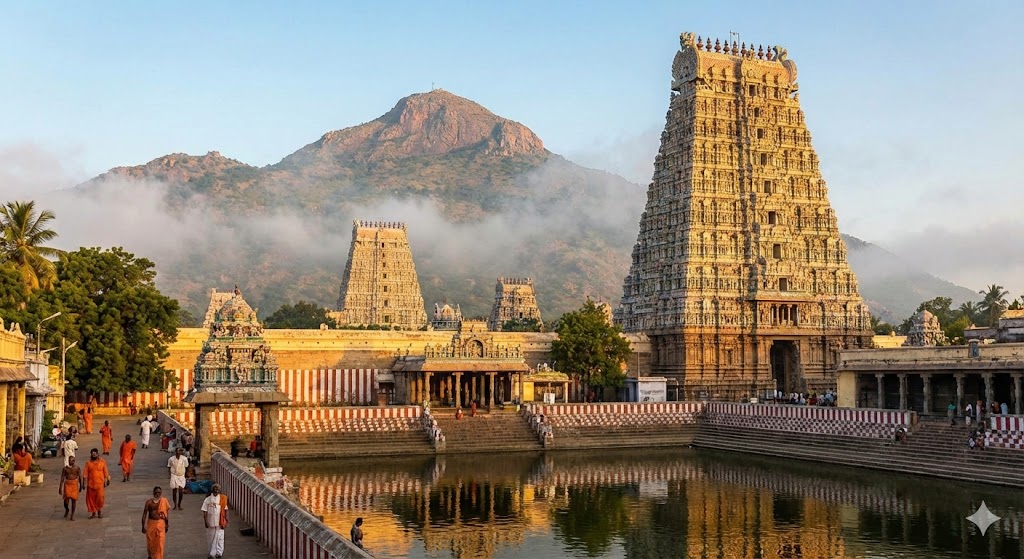
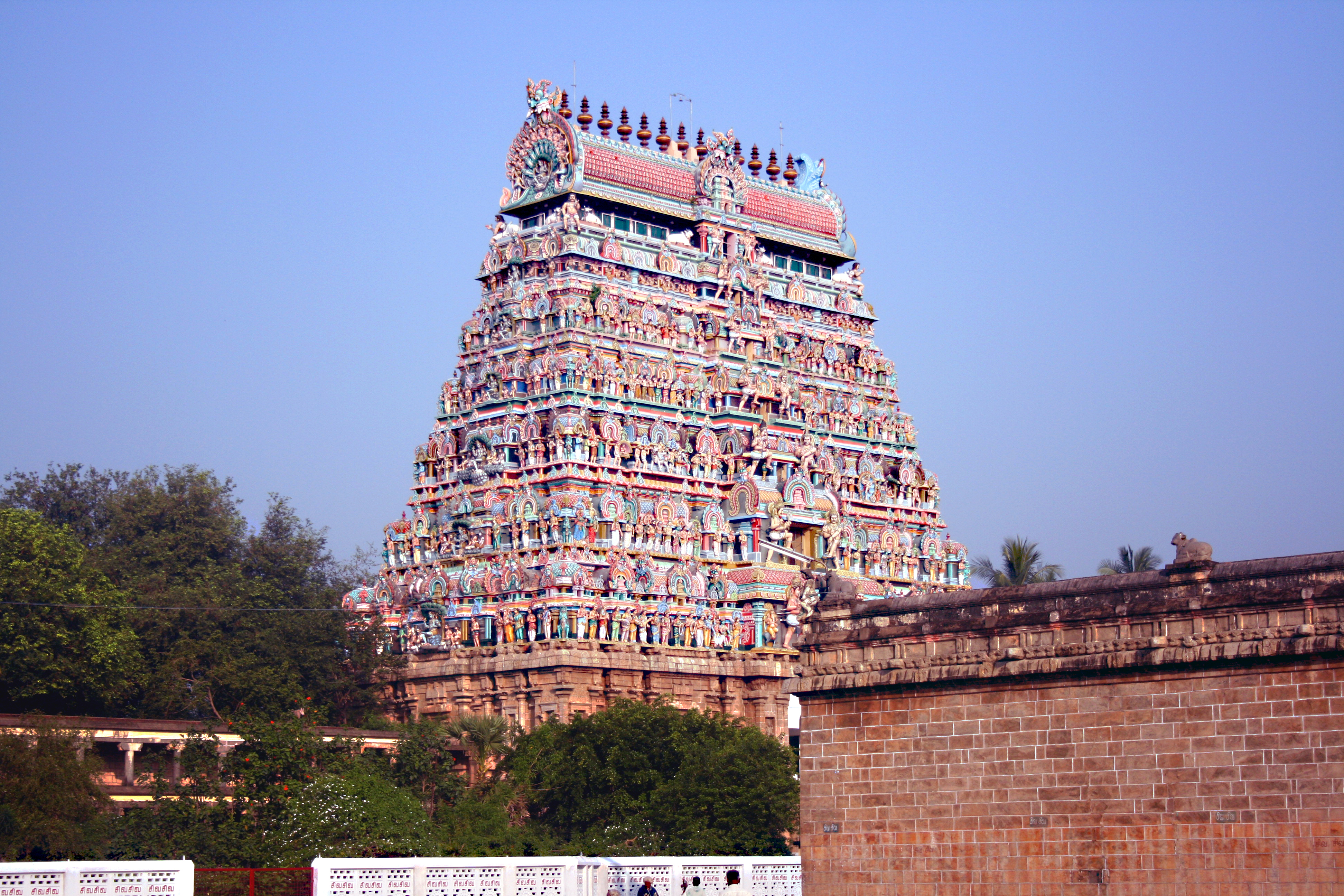
Complete the Pancha Lingalu Circuit
Each of the five Shiva temples embodies a different element of creation. Explore them all.


Complete Jambukeswarar Temple Guides
Plan Your Visit
Temple timings, how to find the Jala Lingam underwater, the narrow door to the sanctum, and everything you need to know before visiting Thiruvanaikaval.
The Priest Who Becomes the Goddess
Every day at noon, a male priest fully dresses as Goddess Akilandeswari to perform puja. This 1,800-year-old ritual exists nowhere else in India — here's what it means and why it began.
The Eternal Spring: Water That Never Stops
A natural underground spring has fed the inner sanctum of Jambukeswarar Temple for at least 1,800 years. Here's what science says, what devotees experience, and why the water level changes with the moon.
Srirangam & Jambukeswarar: The Island of Two Faiths
Srirangam Island holds both the world's largest functioning Hindu temple (Ranganathaswamy) and Jambukeswarar — a Vaishnavite and Shaivite site on the same island. A complete guide to visiting both in one day.
Explore More Sacred Stories
Discover the legends and mysteries of India's ancient temples
View All Stories